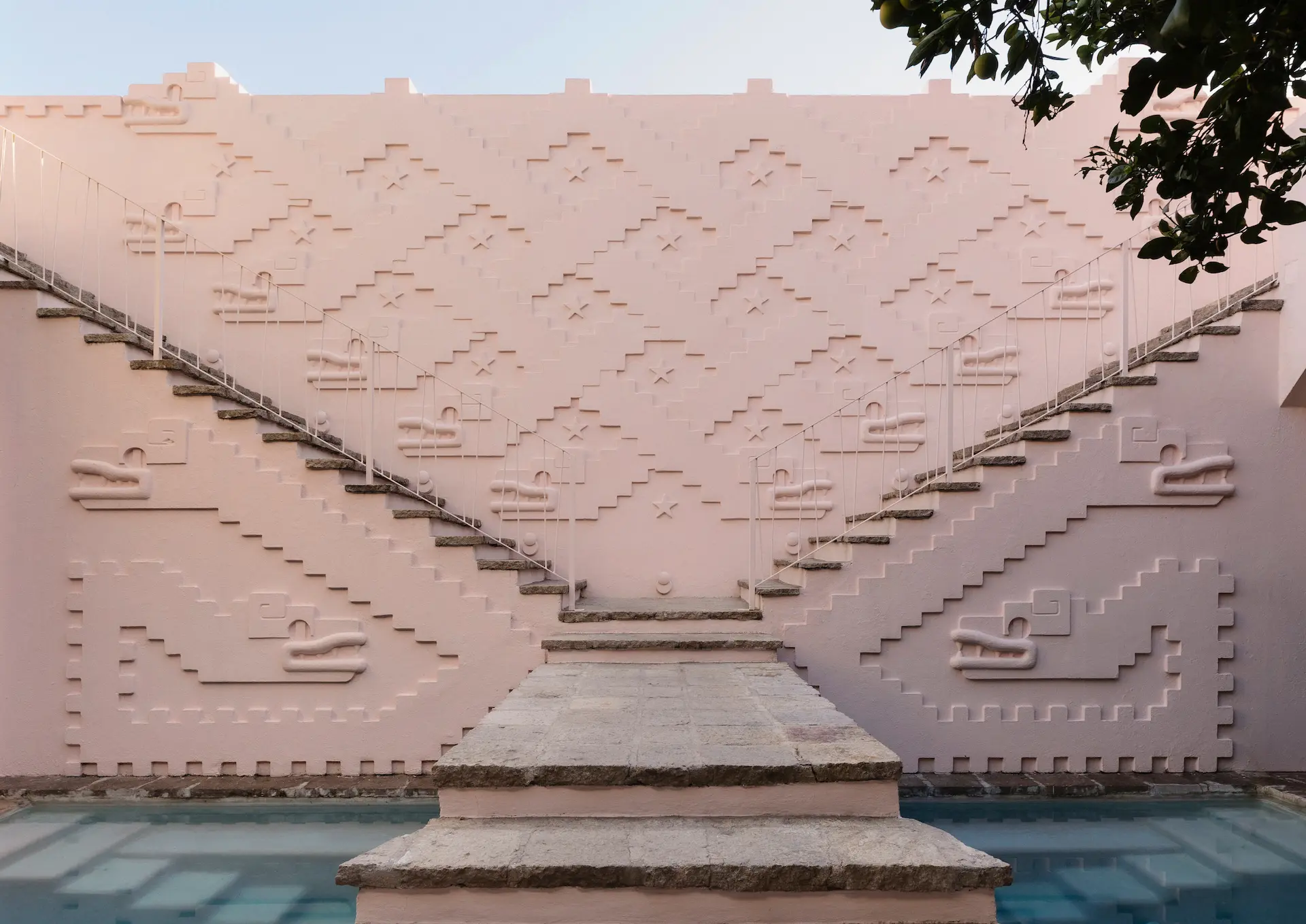
San Miguel became an art town on purpose. A painter fell for the light here, a school opened, then another, and the students never quite left. Today the art sits in three kinds of places: a converted textile mill full of galleries, the old schools that started it all, and houses like ours that keep it on the walls. Here's how we'd spend a day with it.
At a glance
| Place | What it is | When to go | Where |
|---|---|---|---|
| Fábrica La Aurora | Former textile mill, now galleries, studios, design shops and cafés | Daily 10am-6pm, Sundays 10am-5pm | Calzada de la Aurora s/n |
| Instituto Allende | Visual arts school opened in 1950, with a café and galleries on its front plaza | Morning, before the afternoon light flattens the courtyards | A few blocks southwest of the town center |
| Our house | Works and motifs by Pedro Friedeberg in the courtyards and suites | Whenever suits you, if you're staying with us | Jesús 17, Zona Centro |
Fábrica La Aurora: start here if you have one afternoon
Fábrica La Aurora is where you'll find the most galleries under one roof in San Miguel. For about nine decades it was a working textile factory, one of the town's big employers. The looms are gone and the old mill is now an arts and design center, with painters' and sculptors' studios, jewelers, antiques and home shops, and a few places to sit down and eat.
The galleries and shops open every day from 10am to 6pm, and close an hour earlier on Sundays, at 5pm. The center's own directory splits the mill into sections A through E and lists, among dozens of others, SualGlass Studio & Gallery for glasswork, the Café de la Aurora, and a wine tasting room, La Santísima Trinidad. Artists come and go, so treat any list as a starting point rather than a promise.
Our advice: go without a plan. Walk the sections in order, let an open studio door pull you in, and stop for a coffee halfway. If you're thinking of buying something large, ask about shipping before you fall in love with it. The front desk number on the center's site is (415) 152 13 12, and we're glad to arrange your ride there and back.
The Instituto Allende: where the art colony took root
The Instituto Allende is the reason so many painters from the United States and Canada ended up in San Miguel. It opened as a visual arts school in 1950 and has offered degrees in visual and fine arts with the Universidad de Guanajuato.
Go for the building as much as for the art. The family of the Conde de Canal began building it in 1735 as a country residence, and in 1809 it passed to the Discalced Carmelite sisters. The school occupies the rear of the complex and its gardens; the front is a plaza with a café and several galleries. Galería Pérgola, opened in 1951 as the Instituto's exhibition space, holds a large collection of work by Mexican artists in many styles and media.
Every few months the central plaza hosts the Feria de Lana y Latón, a large crafts fair with vendors from across Mexico. The dates move around, so ask us before you arrive and we'll tell you whether your stay lines up with one.
The story behind the Instituto starts a little earlier. In 1927 the Peruvian diplomat and artist Felipe Cossío del Pomar visited San Miguel and was taken with the quality of the light. More than ten years later he founded the Escuela Universitaria de Bellas Artes in the former Convento de Nuestra Señora de la Concepción, a convent that had been serving as a barracks. That first school is where the town's second life as an art colony began.
Pedro Friedeberg, at home with us
We'd be leaving something out if we didn't mention our own walls. Pedro Friedeberg is the Mexican-born artist and designer best known for the Hand Chair, and for treating furniture as fine art. His surreal, ornate style runs through our architecture and interiors: reliefs, murals and motifs in the courtyards and in the suites.
The piece most people photograph first is the double Chichimeca staircase, its geometric reliefs rising above the courtyard pool among the lemon trees. In the Alma Suite, Friedeberg's Aztec monkey reliefs crown the fireplace. Each of our six suites has its own custom artwork and mid-century furniture.
This isn't a public gallery. The work is part of the house, there for the people staying in it, and it's at its best in the quiet hours. You're always welcome in the courtyard.
Around the Parroquia and the main square
The historic center itself is part of the reason artists came. San Miguel's centro was declared a national monument in 1926, which restricted new building and kept the old facades that painters and filmmakers have used as a backdrop ever since, and the town was named a UNESCO World Heritage Site in 2008.
The main square and the Parroquia de San Miguel Arcángel are the natural place to begin or end a gallery day. The tourist information office on the Plaza Principal, at number 8, hands out street maps and can arrange city tours in Spanish or English if you'd like someone to walk you through the history.
How we'd plan the day
Morning: breakfast on the terrace, then the Instituto Allende while the courtyards are cool and the plaza café is quiet.
Afternoon: Fábrica La Aurora after lunch. Give it at least two hours, and remember the Sunday close at 5pm.
Evening: back to the courtyard, then dinner. We don't have a restaurant of our own, so we keep a handpicked list of partner restaurants in town, and we'll book your table.
If you'd rather go with a guide, our experiences program, The Voyage Within, has a Create stream for culture and art. Tell us what you love, painting, textiles, design, and we'll shape the day around it. Take your time, there's no rush here.